
Most failed gate operators were never the wrong brand. They were the wrong size. An operator asked to move more weight, over more length, more times a day than it was rated for will work perfectly for a year and then start failing in ways that look like electrical faults.
Three numbers decide the specification: gate weight, gate length, and cycles per day. Everything else, including which gate opener a supplier happens to stock deepest, is downstream of those three.
This guide covers how to estimate those numbers, how to read them against a rated capacity, when to choose DC over AC, which UL 325 class applies to your property, and how to read an operator datasheet properly. By the end you should be able to name a model rather than a brand. If you are still deciding on the gate itself, start with automatic gate installation in Los Angeles.
Start with the gate, not the motor
Every sizing mistake we correct starts the same way, with someone choosing an operator and then checking whether the gate suits it. The gate is the fixed constraint. The operator is the variable.
Weight, length and leaf count
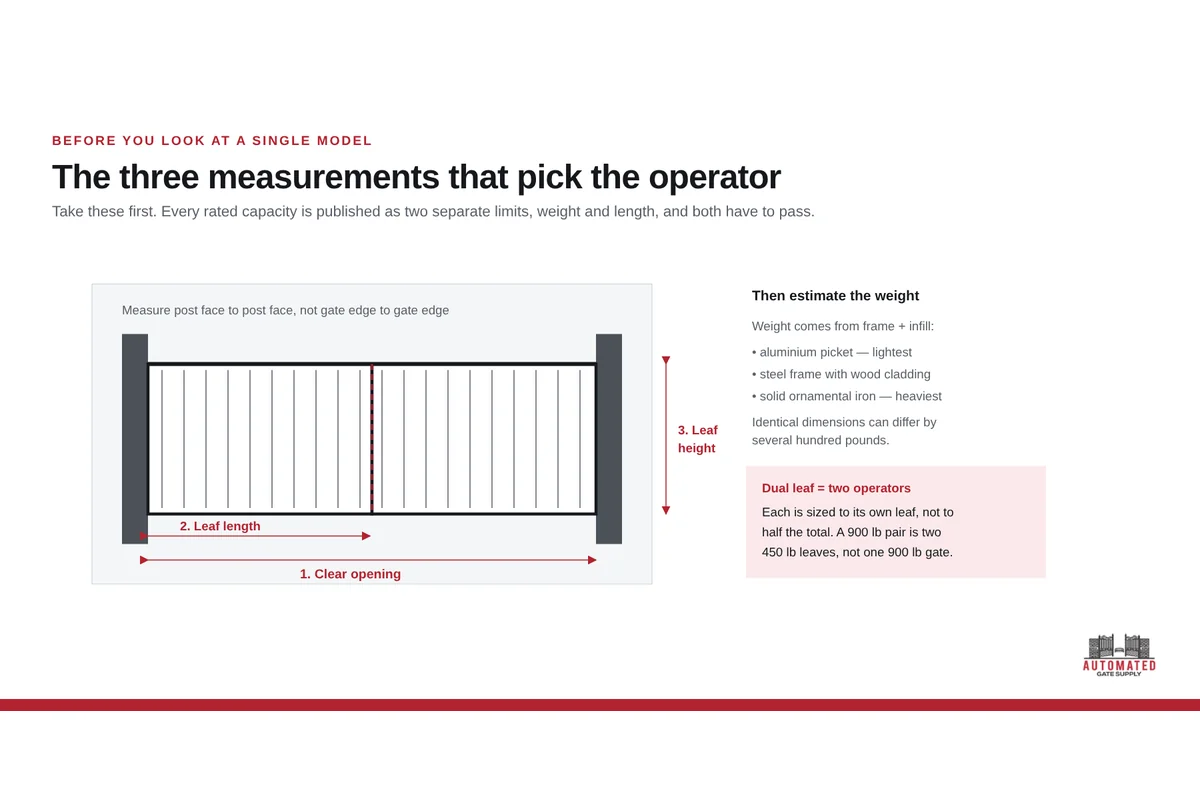
Gate weight is estimated from material, frame and infill rather than guessed. An aluminium picket gate, a steel frame with wood cladding and a solid ornamental iron leaf of identical dimensions can differ by several hundred pounds, which is the difference between an 800 lb-rated operator and a 2,000 lb-rated one.
Estimate it before you specify, then confirm it. A fabricator can give you an actual weight for a gate they are building, and for an existing gate a weighing at the hinge is more reliable than arithmetic.
Length matters independently of weight. A long, light gate puts leverage on the operator arm and the hinge posts that a short, heavy gate does not, which is why rated capacities are published as two separate limits rather than one combined figure.
Leaf count changes the whole specification. A dual-leaf gate needs two operators, and each is sized to its own leaf rather than to half the total, so a 900 lb pair is two 450 lb leaves and not one 900 lb problem.
Swing vs. slide vs. cantilever constraints
The site usually decides this, not preference. A swing leaf needs an arc as deep as the leaf is long, kept clear of driveway, planting and parked cars, and it needs level ground through that arc.
Slide gates need the space sideways instead. A conventional rolling slide gate needs roughly the width of the opening again as backrun alongside the fence line, and it needs ground level enough for a track to stay true.
Cantilever is the answer when the backrun is sloping, uneven or crossed by a drainage line, because the gate carries its weight on a counterbalance rather than on the ground. It costs more in hardware and needs around half the opening width again in counterbalance, and on the wrong site it is the only configuration that works at all.
Overhead and barrier configurations exist for cases neither swing nor slide fits, such as a constrained industrial opening or a parking lane where a barrier gate controls traffic rather than securing a perimeter. What the site allows is a survey question, and it feeds directly into what an installation costs.
Sizing the operator
Size to the rated maximums with headroom, never to them. The table below maps configuration to the stocked models we specify most often, and the capacities come from each manufacturer’s published data rather than from a rule of thumb.
| Configuration | Max gate weight | Max gate length | Duty rating | Example stocked models |
|---|---|---|---|---|
| Residential swing, AC | 800 lbs | 20 ft | Continuous | All-O-Matic SW-300 AC |
| Residential swing, DC with battery backup | 1,200 lbs | 18–20 ft | Continuous | All-O-Matic SW-300 DC PRO, Ramset 300 DC |
| Heavy or ornamental swing | 2,000–5,000 lbs | 22–30 ft | Continuous | All-O-Matic SW-350 DC PRO, SW-375 DC |
| Residential slide | 800–1,800 lbs | 25–35 ft | Continuous | LiftMaster RSL12UL, Ramset 100 DC |
| Commercial and high-traffic slide | 1,500–3,000 lbs | 50–75 ft | Continuous | LiftMaster CSL24UL, SL3000UL, HDSL24UL |
Read the two limits as separate tests. The SW-350 DC PRO is rated to 2,000 lbs but only 22 feet, while the SW-375 DC reaches 5,000 lbs and 30 feet, so a long light gate and a short heavy gate can land on different models for opposite reasons.
Weight and length capacity
A rated maximum is a limit, not a target. An operator moving a gate at 95% of its rated weight draws near its peak current on every cycle, runs hotter, and wears its gearbox and clutch faster than the same operator at 60%.
Specify with headroom on both limits. If your gate is at or above either published figure, the next model up is cheaper than the replacement, which is the whole of messaging on this page.
Two conditions push you up a size even when the raw numbers fit: a gate that will gain weight later, and a gate that already drags. If the gate does not move freely by hand through its full travel, the operator inherits that resistance as load every cycle.
Cycles per day and duty cycle
Duty cycle is the percentage of an hour an operator can run without overheating. It is the specification that decides whether an operator lasts ten years or eighteen months, and it is the one most often missing from a quote.
Cycles per day is the input. A single-family driveway might see six to twenty cycles a day. A small multifamily building sees several hundred. A commercial site with a delivery yard can run into the thousands, and a gate at 4,000 cycles a month is a different machine from one at 400.
Run the arithmetic against the rated duty cycle rather than against the daily count. Twenty cycles spread across a day is a light load. Twenty cycles inside twenty minutes at school pick-up is a thermal problem. Every operator in the table above is rated continuous duty, which is exactly why we specify them: a residential-grade unit with an intermittent rating on a bunched cycle pattern is the most common early failure we see.
Continuous-duty equipment costs more up front and is the correct answer where the cycle pattern is bunched rather than spread. Where cycles are genuinely low and spread out, paying for continuous duty is money you do not need to spend, and we will tell you so.
Hillside, wind-load and long-driveway factors
Three local conditions change the specification here in ways a national spec chart does not cover.
Slope loads the operator on every cycle. A gate on a graded driveway either swings downhill and needs controlled stopping, or uphill and fights gravity through its whole arc, and both push you toward more capacity than the flat-ground figure suggests.
Wind load is the one competitors ignore. A solid-infill gate in a canyon is a sail, and the wind load across that area is a real force the operator and the hinge posts absorb on every gust, which is why the same gate design specified in picket and in solid panel are not the same specification.
Long driveways bring voltage drop. On the 150 ft to 450 ft runs common on private LA driveways, undersized conductors deliver less voltage than the control board expects, and the symptoms read as board faults years later.
Not sure what your gate weighs? Send us the dimensions and material and we will size the operator for you, no charge and no obligation (contact us).
AC vs. DC operators
For outage-prone and hillside properties in Los Angeles, specify DC with battery backup. That is a position, not a preference, and the reasoning is below.
Power draw and battery backup behaviour
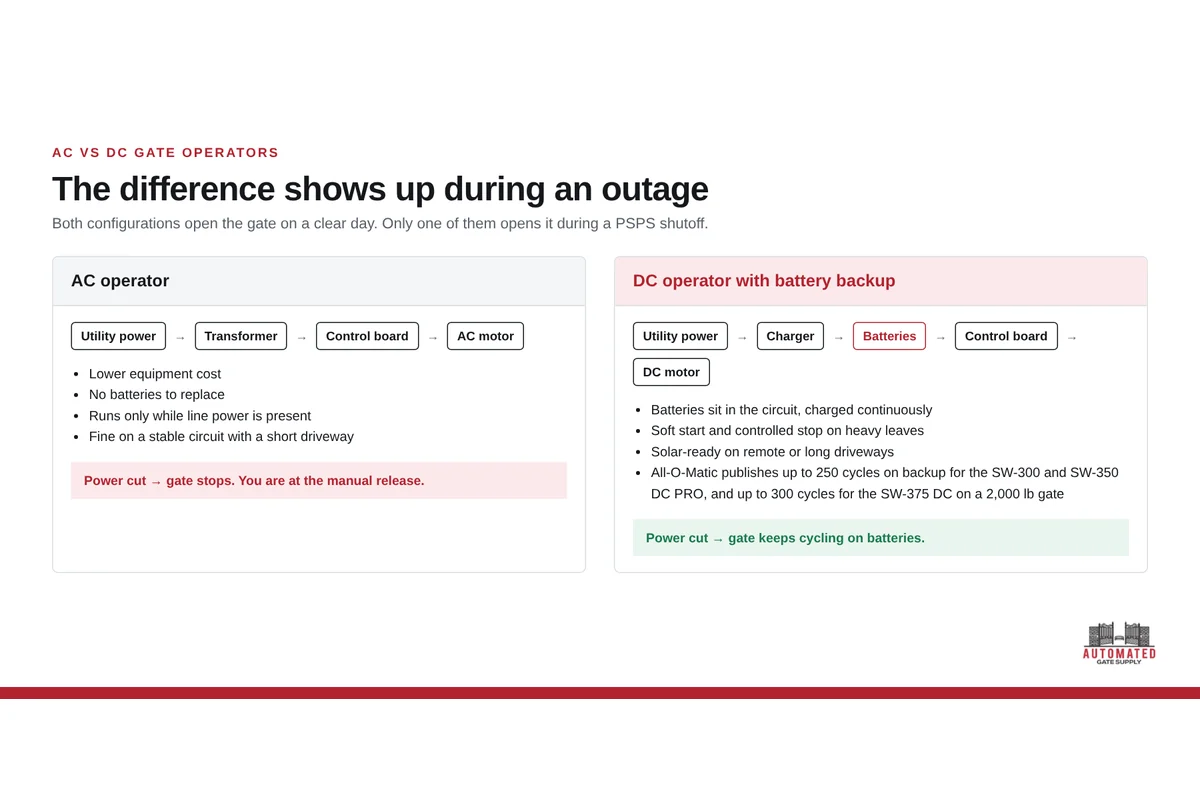
A DC operator runs from a low-voltage supply with batteries in the circuit, charged continuously and drawn on when line power drops. The gate keeps cycling on batteries for a finite number of cycles before it needs power back. All-O-Matic publishes up to 250 cycles for the SW-300 DC PRO and SW-350 DC PRO on their integrated 12 VDC batteries, and up to 300 cycles for the SW-375 DC on a 2,000 lb gate.
An AC operator has no equivalent behaviour. When line power drops it stops, and access depends on the manual release. For a household that includes a vehicle inside the gate during a PSPS event, that is the difference between an inconvenience and being stuck.
DC also gives finer control over speed and force, which matters on heavy leaves where a soft start and a controlled stop reduce stress on the gate and the hinge posts.
The trade-off is real. DC operators cost more, the batteries are consumables on a replacement cycle, and a backup nobody tests is discovered flat during the outage it existed for. Solar changes this equation less than people expect.
Which one to pick for outage-prone areas
The table below is how we decide, and it lands on DC more often than not in this market.
| Condition | Specify | Why |
|---|---|---|
| Hillside or canyon property | DC with battery backup | Outage frequency, single access route |
| PSPS-affected circuit | DC with battery backup | Planned shutoffs last hours or days |
| Heavy or ornamental leaf | DC | Soft start and controlled stop |
| High cycle commercial site | Case by case | Duty cycle and continuous rating decide it |
| Stable circuit, short driveway | AC acceptable | Lower cost, manual release is workable |
The bottom row is the honest one. On a flat property with a reliable circuit and a second way out, an AC operator is a reasonable specification and the DC premium buys you less.
UL 325 classes I to IV and what they mean for you
UL 325 sorts gate operators by the type of access the site has, and the class determines what the installed system must include. The classes describe usage, not quality, so a Class I operator is not a lesser machine than a Class III one.
| Class | Access type | Typical application |
|---|---|---|
| Class I | Residential | One to four single-family dwellings |
| Class II | Commercial, general access | Multifamily, hotel, retail parking |
| Class III | Industrial, limited access | Factory, loading dock, yard |
| Class IV | Restricted access | Guarded or monitored industrial sites |
Across all classes, the standard requires a primary inherent entrapment protection system in the operator plus an independent secondary means, which in practice is a monitored photo eye, an edge sensor or another approved device. The class does not change that the protection is required; it changes which devices and configurations are acceptable for the site, so getting the class wrong means installing a system that cannot pass inspection. The stocked commercial operators above are UL usage classification I, II, III and IV, which is why the same model appears on a driveway and on a loading dock.
The practical consequence for a homeowner is that safety devices are not an upsell, they are what the standard requires the operator to be installed with. The full compliance treatment, including ASTM F2200 and testing intervals, sits separately.
Residential vs. commercial grade
When residential equipment is the wrong economy
The cheapest operator that fits is frequently the most expensive decision on the project. Residential and commercial grade equipment differ in four places that all show up after the warranty expires.
Duty cycle is the first. A residential-rated operator asked to run a commercial cycle pattern overheats, and thermal cycling is what kills gearboxes.
Chassis and gearbox are the second. Heavier castings, better bearings and a sealed enclosure cost more to build and survive weather, dust and vibration for longer.
Serviceability is the third, and it is the one owners feel. Commercial-grade lines tend to have replaceable boards, limits and clutches, so a failure is a part rather than a new operator.
Parts availability is the fourth. When a board fails in year six, a serviceable line means we pull the part off a shelf, and a discontinued consumer unit means replacing the whole assembly. That difference is the argument for non-proprietary equipment in one sentence, and it is why our gate operator service work leans on stocked lines.
The honest counterweight: on a genuinely low-cycle residential gate, commercial grade is capacity you will never use. Right-sized beats both cheap and oversized.
Accessories that should be specified up front
These cost less installed alongside the operator than retrofitted afterwards, because the trench is open, the conduit is unpulled and the board is unmounted.
Safety devices
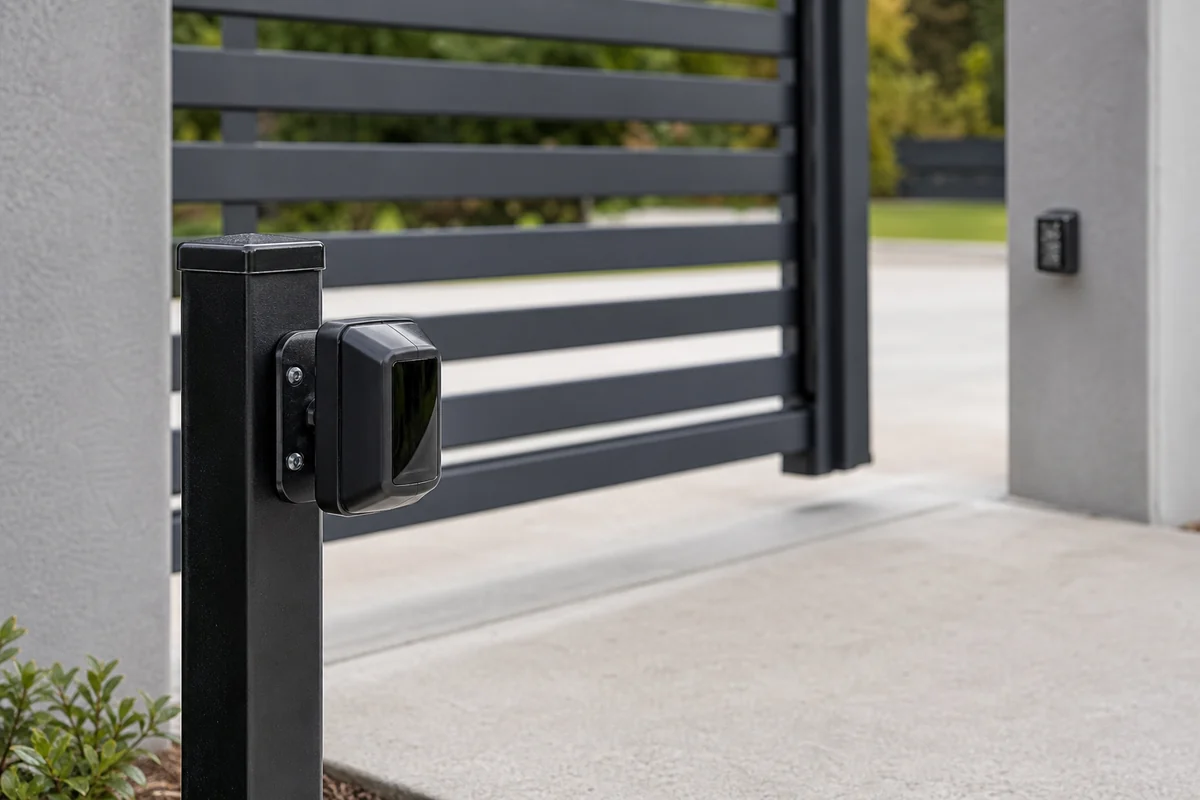
Photo eyes and edge sensors are UL 325 obligations rather than options. A LiftMaster LMRRUL monitored photo eye or an EMX IRB-MON2 across the gate path is the common specification, and modern boards expect to see a monitored device on the circuit.
Edge sensors go where a pinch or shear point exists that a beam cannot cover. Mounting height and beam alignment are commissioning decisions, not installation afterthoughts, and a beam set too high clears exactly what it was fitted to catch.
Access control
Entry devices follow who needs access and how often. A keypad such as the Seco-Larm SK-1123-SDQ or LiftMaster KPW250 handles household and staff codes; a receiver and remotes cover daily drivers; a DoorBird video intercom covers deliveries and guests.
Specify the receiver alongside the operator so frequencies and coding match from day one. Ordering remotes later from the shop is straightforward when the receiver was chosen deliberately and awkward when it was not.
Loop detectors and exit devices
Loop detectors sense vehicles in the ground and drive three separate functions: free exit, safety, and shadow protection under an open gate. Diablo DSP-7LP, Reno A&E BX-4 and LiftMaster LOOPDETLM are the stocked options, and the gate accessories category carries the supporting hardware.
Loops are cut into the driveway, which means specifying them after the driveway is finished costs saw work. Decide before the concrete, not after. Chain, V-groove wheels and hinges are specified at the same time from gate hardware, since a slide gate operator is only as good as the drive train it pulls on.
Spec sheet walkthrough: reading a real operator datasheet
Every specification decision on this page is answerable from one document, and most people never open it. Here is what to read on an operator datasheet and what each line actually tells you.
| Datasheet line | What it tells you |
|---|---|
| Supply voltage | Circuit required, AC or DC architecture |
| Current draw | Breaker sizing and conductor gauge |
| Max gate weight | The limit to specify below, not at |
| Max gate length | Independent leverage limit |
| Duty cycle | Whether the cycle pattern will overheat it |
| Limit type | Mechanical or electronic, and how it is set |
| Control board features | Loop inputs, monitored device support, timers |
| UL 325 class | Which sites it may be installed on |
| Enclosure rating | Weather, dust and coastal exposure |
| Warranty | Term, and what voids it |
Two lines deserve a closer read. Current draw is what sizes your circuit and your conductor over a long run, so it belongs in the electrical conversation and not just the equipment one. Control board features decide what you can add later without replacing the board, which is where a slightly better board pays for itself in year three.
Take the LiftMaster CSL24UL as the worked example. LiftMaster publishes it as a 24 VDC high-traffic commercial slide operator rated for gates up to 50 feet and 1,500 lbs, continuous duty, with a commercial oil-bath gearbox at 10:1 wormgear reduction, #41 black oxide chain, 120/230 V single-phase power, UL usage classification I through IV, and a 5-year commercial and 7-year residential warranty. Those figures are what qualify or disqualify it for a given opening, and they come from the specification sheet rather than from experience, because that is what a spec is for.
Matching your gate to a model: quick reference
The table below maps common configurations in this market to stocked models. Confirm every capacity against the datasheet before ordering.
| Scenario | Configuration | Suggested stocked models |
|---|---|---|
| Single swing under 800 lbs, low cycle | Residential swing, AC | All-O-Matic SW-300 AC |
| Heavy ornamental dual swing | Two operators, DC preferred | All-O-Matic SW-350 DC PRO, SW-375 DC |
| Hillside property, outage-prone | DC with battery backup | All-O-Matic SW-300 DC PRO, Ramset 300 DC |
| 25 to 35 ft residential slide | Residential slide, chain drive | LiftMaster RSL12UL, Ramset 100 DC |
| High-cycle commercial slide | Commercial slide, continuous duty | LiftMaster CSL24UL, SL3000UL, HDSL24UL |
| Slide gate over 50 ft or over 2,000 lbs | Heavy-duty commercial slide | LiftMaster HDSL24UL, rated 75 ft and 3,000 lbs |
| Fire department access on any powered gate | Approved override device | DKS 1400-080, 1401-080, 1402-080 lock boxes |
Names you will meet elsewhere in this category include HySecurity, FAAC, Viking and Nice. We do not stock them, so we do not recommend them, and we will say plainly when a use case sits outside what we carry rather than talking you into something that fits our shelf.
Frequently asked questions
How do I size a gate operator to my gate?
Take three numbers: gate weight, gate length and cycles per day. Match them against the published maximums on the datasheet and specify below both limits rather than at them. If the gate does not move freely by hand, fix that first, because the operator inherits the resistance as load on every cycle.
What is duty cycle, and why does it kill cheap operators?
Duty cycle is the percentage of an hour an operator can run without overheating. A gate cycling twenty times spread across a day is a light load; twenty times in twenty minutes is a thermal one. Residential-rated equipment on a bunched cycle pattern overheats, and repeated thermal cycling is what destroys gearboxes and boards well before the mechanical parts wear out.
AC or DC, and when does battery backup actually matter?
DC with battery backup on any hillside, canyon or PSPS-affected property, where an outage can leave a vehicle inside a closed gate. AC is a reasonable specification on a flat property with a reliable circuit and a second way out. The batteries are consumables, so a backup that is never tested is not a backup.
Which UL 325 class applies to my property?
Class I covers one to four single-family dwellings. Class II covers multifamily, hotel and retail parking. Class III covers industrial sites with limited access, and Class IV covers restricted, monitored sites. The class describes the access type rather than the quality of the machine, and it determines what the installed system must include to pass inspection.
Can I reuse my existing operator with a new gate?
Only if the new gate is no heavier and no longer than the old one, and the operator is within its service life with parts still available. A new gate is frequently heavier than the one it replaces, which quietly puts an adequate operator over its limit. Have the ratings checked against the new gate’s actual weight before you plan on reusing it.
Do I need a bigger operator for a solid gate than a picket gate?
Often yes, on an exposed or canyon site. A solid-infill leaf presents its whole area to the wind where a picket gate lets air through, and that load is carried by the operator, the hinges and the posts. Same dimensions, different specification.
Tell us the gate, and we will spec the operator
Send us the opening width, the leaf length and height, the material and roughly how many times a day the gate will cycle, and we will come back with a model and the datasheet behind it. If you would rather browse first, the gate operator packages are grouped as complete kits, and the installation service covers the work.
Call (818) 765-3636 or send the numbers through our contact page (contact us). We stock the boards, receivers, photo eyes and wear parts for everything we sell, which is what makes a system serviceable in year eight rather than replaceable.