
A complete automatic gate installation is a seven-stage project, and most of the cost sits in the parts you will never see. The gate is the visible half. The electrical run from your panel, the trench and conduit under the driveway, the operator grade and the safety devices are the half that decides whether the system still works in year ten.
That is also where quotes diverge. Two bids on the same driveway can differ by three times because one priced the invisible half and the other left it out.
This guide covers what happens at each stage, when Los Angeles requires a permit, what has to be ready before the crew arrives, what a complete quote itemises, and which mistakes cost the most to fix later.
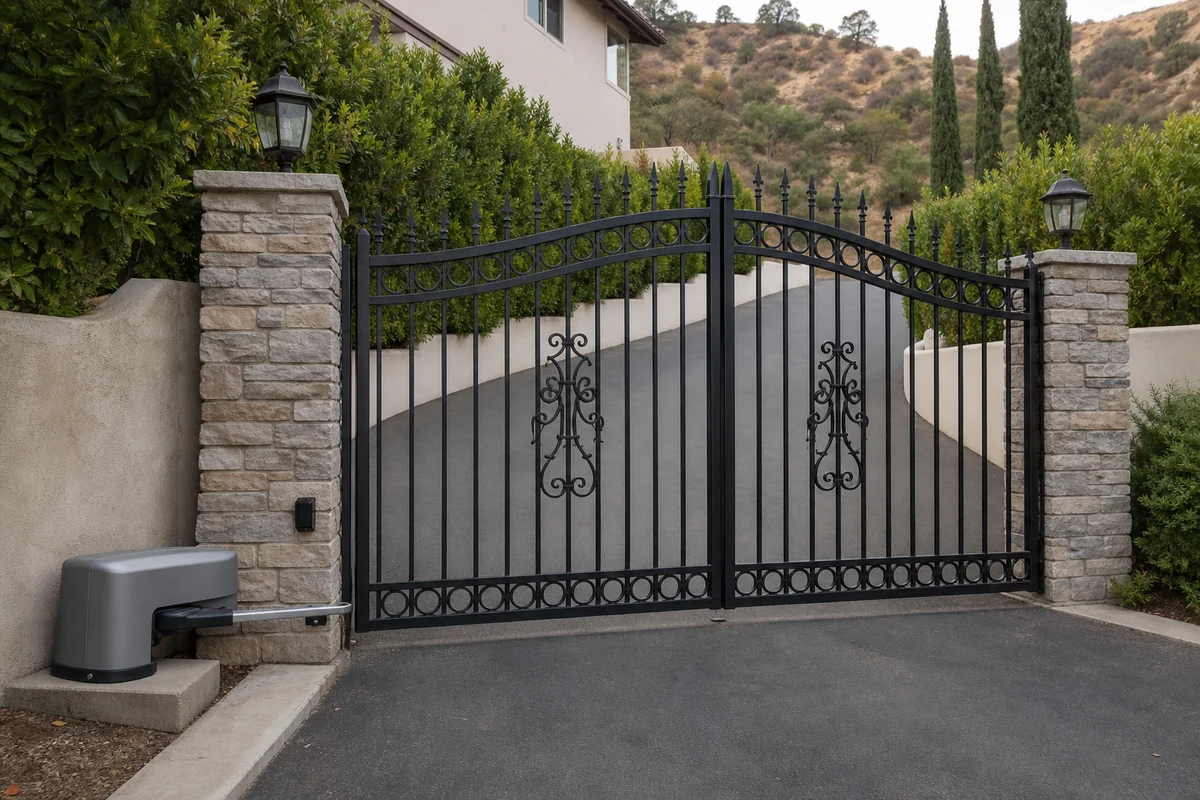
Is your property a good candidate for an automated gate?
Two measurements settle most of this project before anyone talks about brands: how much room the gate has to move, and how far the gate sits from your electrical panel. Our electric gate installation surveys start with both.
Driveway width, slope and swing clearance
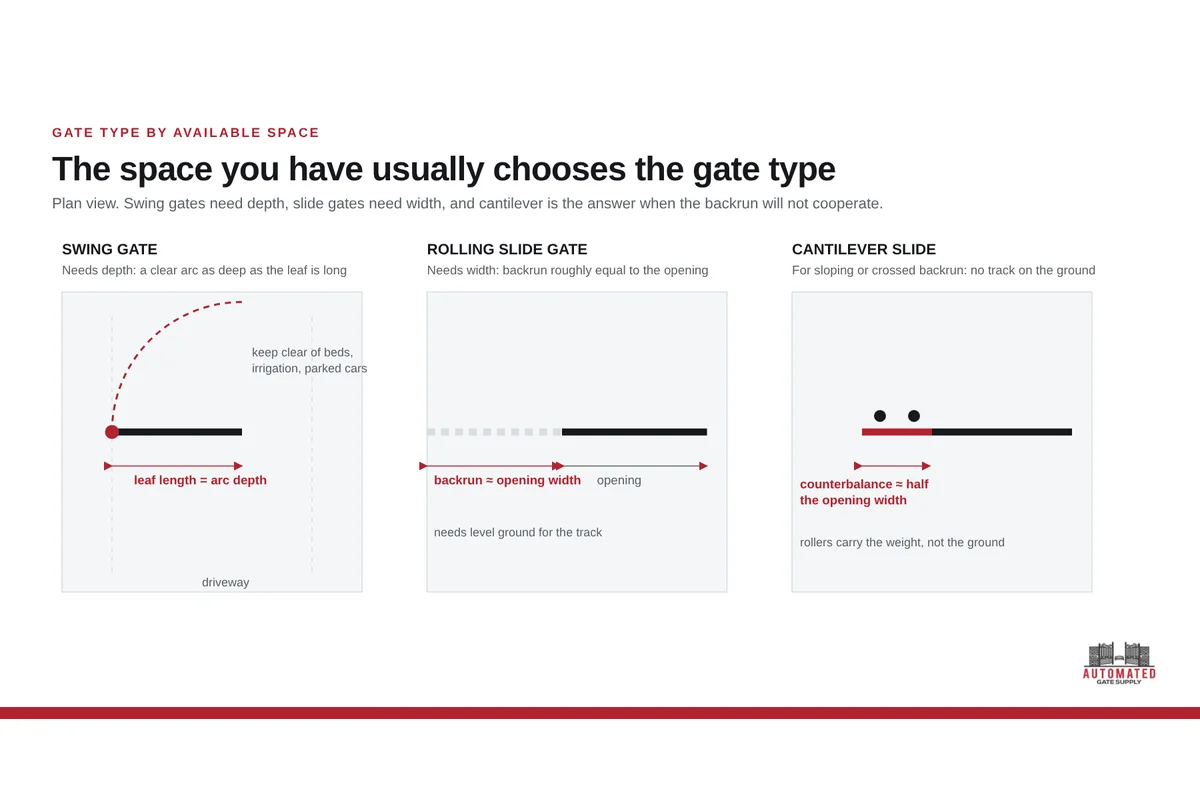
A swing leaf sweeps an arc as deep as the leaf is long. A 12 ft leaf needs 12 ft of clear, level arc, and that arc has to stay clear of the driveway surface, planting beds, irrigation heads and parked cars.
Slope is the constraint that surprises people. A gate swinging uphill drops its leading edge toward the rising grade and binds, so a driveway that climbs away from the street usually forces the gate to swing out toward the street, which then runs into setback and right-of-way limits.
Short driveways push you toward a slide gate. If there is less than a car length between the gate and the garage, an inward-swinging gate cannot open with a car waiting inside the arc.
Slide gates need room sideways instead. A conventional rolling slide gate needs roughly the width of the opening again alongside the fence line to retract into. Where that space does not exist, a cantilever slide gate is the answer, and it needs around half the opening width again as counterbalance.
Automating an existing gate vs. starting fresh
An existing manual gate can be automated if it is rigid, plumb and moves freely by hand. Push it through its full travel. If it takes real effort anywhere in that arc, an operator will not fix the problem, it will absorb the load and fail early.
Check the hinge posts first. Grab the gate at its leading edge and pull. If the post moves, it needs replacing or re-footing, because an operator applies that force several thousand times a year rather than a few times a day.
The frame matters more than the finish. A welded steel or aluminium frame that stays square is a good candidate. A decorative panel that racks in its own frame, a wood gate that has sagged, or ornamental iron hung on 4×4 wood posts is not.
When the answer is no, the honest version is that you are buying a new gate and reusing the opening. That is often cheaper anyway, because automating a marginal gate means paying for the operator twice.
The seven stages of a gate installation
Every complete installation runs through the same seven stages. The order does not change, and skipping one of them is the most common reason a system fails inside three years.
Site survey and measurement
The survey exists to find the expensive surprises while they are still cheap. A technician measures the clear opening, the leaf length, the gate weight or the material it will be built from, and the slope across the swing path with a level rather than by eye.
The most important measurement is the distance from your electrical panel to the gate, because it drives the trenching, the conduit and the wire gauge. It is routinely the largest line item nobody expects.
The survey also records available breaker space, the location of irrigation and buried utilities, the driveway surface that will need cutting and restoring, and whether there is usable signal at the gate for a video intercom.
Equipment selection and lead times
Equipment is specified from three numbers: gate weight, gate length and cycles per day. Those numbers pick the operator, and the operator drives almost everything downstream.
For residential swing gates, an All-O-Matic SW-300 DC PRO is a common specification. For slide gates, the LiftMaster CSL24UL covers a wide band of residential and light commercial work. Complete kits sit in our gate operator packages, and the sizing logic is worth understanding before you compare bids (see how to choose a gate operator).
One decision belongs here rather than later: AC or DC. On a hillside or PSPS-affected circuit, a DC operator with battery backup keeps working through an outage. An AC operator stops dead and leaves you at the manual release.
Custom fabrication and some operator models carry real lead times, and they are the single most common reason a project slips. Ask for the fabrication and equipment lead time in writing before you sign, because a gate that arrives after the trench is dug means paying for two mobilisations.
Trenching, conduit and electrical
Gate operators need a dedicated 20-amp circuit. Sharing a circuit with landscape lighting or a garage outlet is how you get a gate that stalls when something else draws current.
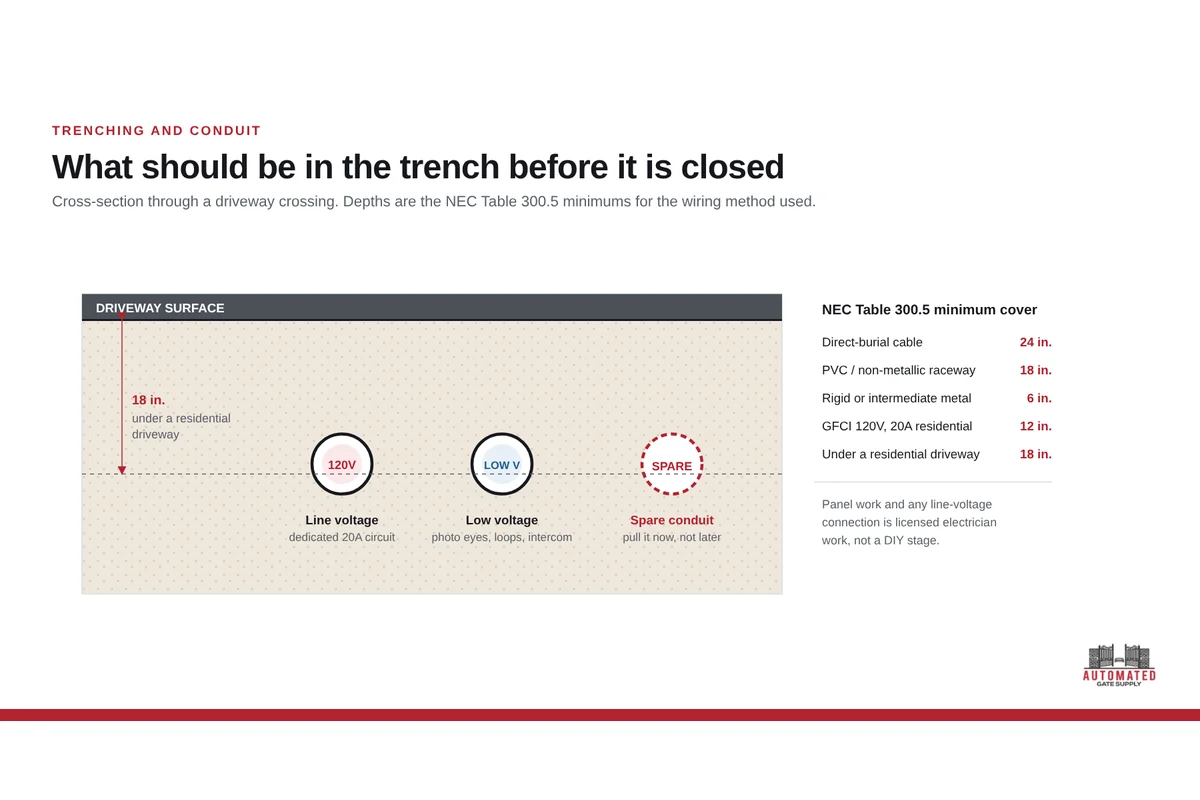
Line voltage and low voltage go in separate conduits. Minimum burial depth is set by the wiring method under NEC Table 300.5: 24 inches for direct-burial cable, 18 inches for PVC and other non-metallic raceway, 6 inches for rigid or intermediate metal conduit, and 12 inches for a GFCI-protected 120-volt residential branch circuit on a 20-amp breaker. Anything crossing a residential driveway goes to 18 inches. The trench has to reach depth before the driveway is closed back up.
While the trench is open, pull one spare empty conduit. Retrofitting a second run later means cutting the same driveway twice, and the spare costs a fraction of the saw work.
Voltage drop is the long-run problem. On the 150 ft to 450 ft runs common on private driveways here, undersized wire delivers less than the board expects, which surfaces as intermittent faults years later.
Panel work and any line-voltage connection is licensed electrician territory. This is not a DIY stage.
Gate and operator installation
Footings come first, and they cure for the period the mix and the operator manufacturer call for before anything is bolted to them. Mounting an operator to green concrete shows up as alignment drift months later.
Slide gates get a mounting pad, a level track or cantilever rollers, AGS V-groove wheels where the design calls for them, and KMC #40 or #41 chain sized to the run. Swing gate arms are mounted so the geometry matches the leaf, not so the bracket merely fits the post.
Limits and force settings are established at this stage. The manual release is fitted and tested now rather than at handover, because it is what you will reach for during the next outage.
Gate hanging and operator mounting is pro-only work. The loads are the reason ASTM F2200 treats gate construction as a safety matter, not only a durability one.
Access control and safety devices
Safety devices are not accessories. UL 325 requires entrapment protection on the installed system, and a modern control board expects to see a monitored device, so specifying it up front costs less than adding it after inspection.
A typical build uses a LiftMaster LMRRUL monitored photo eye or an EMX IRB-MON2 across the gate path, an edge sensor where a pinch point exists, and a loop detector such as a Diablo DSP-7LP or Reno BX-4 for free exit.
Entry devices follow who needs access and how often: a keypad for household and staff codes, a receiver and remotes for daily drivers, and a video intercom for deliveries and guests. Our DoorBird video intercoms solve the delivery problem better than a shared keypad code.
Anything wired into the control board or commissioned as a safety device belongs to a technician. Design help for the full set sits on our access control systems page.
Programming and commissioning
Commissioning is where components become a system. Limits are set, force sensitivity is tuned to the actual gate rather than the factory default, and reversal behaviour is confirmed against every safety device.
Credentials are enrolled next: remotes paired to the receiver, keypad codes issued per user rather than one code for everyone, intercom users invited, and loop sensitivity set so a vehicle triggers free exit and a passing wheelbarrow does not.
Remote programming is the part owners most often need again later, and the full procedure lives on one page: how to program your gate remote.
Final safety test and handover
The last stage is a test, and it is the one most often skipped on a low bid. The gate is run against a solid obstruction to confirm it reverses, and each photo eye is interrupted mid-travel to confirm the gate stops instead of continuing.
The manual release is demonstrated to you, by you, at the gate. Opening your own gate during an outage is not an optional part of the handover.
You should finish holding a documented list of model numbers for the operator, board, receiver, photo eyes and loop detectors, the programmed force and limit settings, permit paperwork, and warranty details.
Keep that list. When a board fails years later, it is the difference between ordering the right part and paying for a diagnostic visit.
Permits and code in Los Angeles
Permitting is where local knowledge earns its keep, and where a national price calculator has nothing useful to say. Rules differ between the City of Los Angeles, unincorporated Los Angeles County, and cities such as Burbank and Santa Monica that run their own departments.
When a permit is required
Electrical work almost always triggers a permit. Adding a dedicated circuit for a gate operator is new branch circuit work, pulled as an electrical permit by the licensed contractor doing the work.
Structural and zoning review depends on what is being built. A building permit is required for a fence, wall or gate structure over 6 feet high measured from the lowest adjacent grade, and Planning reviews front-yard setback and height compliance regardless of whether a building permit applies. In the City of Los Angeles, a gate that encroaches on the public right-of-way needs a revocable permit from the Bureau of Engineering, and a gate above the permitted height, inside a Fence Height District (LAMC 13.10) or within an HPOZ needs a variance from City Planning before anything is issued.
The contractor should pull the permit, not you. A bid that hands permitting to the homeowner, or shows no permit line at all, is telling you how the rest of the job will go.
UL 325 and ASTM F2200 obligations
The two standards cover different halves of the same system. UL 325 governs the operator and the entrapment protection it must be installed with. ASTM F2200 governs the gate: how it is built, how it moves, and the pinch and shear points it must not create.
In practice that means an operator paired with working entrapment protection, no reachable pinch points, screening where a rolling gate could catch a limb, and a system tested to reverse rather than assumed to.
Properly installed and tested safety devices reduce the risk of entrapment. They do not eliminate it, which is why the standards call for periodic testing rather than a single sign-off.
Fire department access requirements
An automated gate across a driveway is an obstacle to emergency response, and LAFD treats it as one. A gate may not reduce the required fire access roadway below 20 feet free and clear, and a project needs an adequate stacking lane so waiting visitors do not block the cross street. Power-operated gates must carry a Fire Department approved override device: a red weatherproof access box mounted on the gate pillar, visible from the approach, holding a two-position switch that drives the gate open and holds it open until the switch is reset, or an approved Knox key switch to the same effect. Key access boxes follow LAFD Requirement #75 under Los Angeles Fire Code section 506.
We stock the DKS lock boxes used for this, the 1400-080, 1401-080 and 1402-080, which are 14-gauge red steel cabinets with a built-in gate activation switch that opens the gate when the padlock is removed and the door is opened.
The failure mode to design around is power loss. A gate that cannot open without electricity delays an engine crew, which is a second argument for a DC operator with battery backup. LiftMaster’s commercial operators handle this in the product itself, auto-opening on loss of AC power or battery depletion for fire department compliance.
Confirm the access method before installation. Retrofitting a compliant device after the gate is hung and the driveway is closed is the expensive order to do it in.
Timeline: the five stages and what controls each one
The table below shows the shape of a residential installation and, more usefully, what actually controls each stage. Ask your installer to put a date range against every row of it — two of the five stages depend on things outside their control, and those are the ones worth pinning down in writing.
| Stage | What it depends on | What delays it |
|---|---|---|
| Survey and quote | Site access, panel location | Scheduling, incomplete measurements |
| Permits and approvals | Jurisdiction, scope of work | HOA review, setback questions |
| Fabrication and equipment | Custom vs stock gate, operator model | Custom ironwork, finish schedules |
| Site work and trenching | Distance to panel, hardscape | Rock, roots, irrigation repairs |
| Install and commissioning | Gate type, access control scope | Concrete cure, missing parts |
Fabrication and permitting are the two stages that move most. A stock operator on an existing serviceable gate is a short job. A custom ornamental dual swing with new columns and a long electrical run is a different project.
What a complete installation quote includes
A complete quote is itemised and names models. That single test separates a proposal you can compare from a number you have to trust.
Line items that should always be listed
Here is what belongs on its own line, and what each line should actually specify.
| Line item | What it should specify | Why it goes missing |
|---|---|---|
| Gate | Material, dimensions, finish, fabrication | Rolled into a lump sum |
| Operator and board | Make and model number, AC or DC | Listed only as “gate opener” |
| Safety devices | Photo eye and edge sensor models | Treated as optional extras |
| Access control | Keypad, receiver, remotes, intercom | Quoted later at retail |
| Electrical and trenching | Circuit, conduit, trench length, restoration | Assumed to be someone else’s scope |
| Permits and labour | Who pulls permits, labour hours | Omitted to lower the headline |
| Commissioning and warranty | Safety testing, warranty terms | No line, so no accountability |
Two lines deserve attention. The operator line varies most in real terms, because residential and commercial grade equipment doing identical work differ by years of service life; our gate operator service page covers that gap. The electrical line varies most by site.
Six things missing from suspiciously low bids
When a bid lands far under the others, it is usually missing the same six things:
- Monitored safety devices, or safety devices at all
- A permit line, and a named party responsible for pulling it
- A dedicated circuit rather than a tap off an existing one
- Trenching to the required depth, with separate conduits
- Battery backup on an outage-prone circuit
- Commissioning, safety testing and documented settings
Each is cheaper to include now than to add later (see the full cost breakdown), and the sixth is the cheapest to skip and the most expensive to discover you skipped.
If you already have a quote in hand and you are not sure what is in it, send it over and we will tell you what is missing before you sign anything (contact us).
Site preparation checklist for property owners
Work through this before the install date. Every item is something that stops a crew mid-job.
- Confirm panel capacity and available breaker space for a dedicated 20-amp circuit
- Confirm gate posts or columns are built, plumb and cured
- Confirm the slab or footing location for a slide gate operator
- Grade and drain the gate area so water does not pond at the operator or track
- Decide on driveway surface restoration where the trench crosses it
- Clear equipment access to the gate area, including width for delivery
- Clear the swing or slide path of planting, irrigation heads and stored items
- Mark irrigation lines, low-voltage lighting and private utility runs
Item eight causes the most avoidable damage. Those runs are rarely on any drawing, and a trench finds them reliably.
Commercial and multifamily installations: what changes
The equipment looks similar and the engineering does not. What changes is cycle count, and cycle count changes everything downstream.
A single-family gate might run a handful of cycles a day. A 40-unit building runs that before breakfast, which moves you into commercial-grade operators, higher duty cycle ratings and a chassis built for the volume.
Free exit becomes a requirement rather than a convenience, so loop detectors move from optional to specified. Emergency access gets stricter, ADA considerations apply at pedestrian entries, and credential management becomes an operating cost instead of a one-time setup.
That last point is what property managers feel. Every move-out is a credential to revoke and reissue, which is why the access platform matters more than the gate (access control systems).
Common installation mistakes and what they cost later
These recur, and each has a predictable downstream cost.
| Mistake | What it costs later |
|---|---|
| Underspecified operator | Replacement in two to three years instead of ten |
| No battery backup on a PSPS circuit | Manual release every outage, or a trapped vehicle |
| Wire gauge too small for the run | Intermittent faults that read as board failures |
| Photo eyes at the wrong height | A gate that clears a beam it should have caught |
| No spare conduit under the driveway | Cutting and restoring the same driveway twice |
| Safety test skipped at handover | Unverified reversal, and no baseline to compare against |
| Gate hung on inadequate posts | Sagging leaf, binding travel, early operator failure |
The first row is the expensive one. An operator specified at the top of its rated capacity works on day one and wears out fast, which is why sizing below the maximum is the whole discipline (see how to choose a gate operator).
Wear parts are the predictable part of ownership. Chain, wheels, hinges and photo eyes are consumables on a gate that runs daily, and we stock them in gate hardware and gate accessories so a worn part is a part order rather than a system replacement. When something has already failed, electric gate repair is faster than a fresh installation quote, and the full catalogue is online.
Frequently asked questions
How long does an automatic gate installation take, start to finish?
The installation itself is the short part. Most of the calendar is survey, permitting and fabrication, so ask for a stage-by-stage schedule rather than a single completion date. A stock operator on an existing serviceable gate finishes far sooner than a custom ornamental gate with new columns and a long electrical run.
Do I need a permit for a gate in Los Angeles, and who pulls it?
Yes for the electrical work: powering the operator motor is a new branch circuit and needs an electrical permit. A building permit is added if the fence, wall or gate exceeds 6 feet from the lowest adjacent grade, and Planning reviews front-yard setback and height either way. A gate reaching into the public right-of-way needs a separate revocable permit. The licensed contractor should pull all of it, and their bid should say so on its own line. Ask for the permit number once it has been issued.
Can I automate the gate I already have?
Often, if it is rigid, plumb and moves freely by hand through its full travel on sound hinge posts. If it binds anywhere, sags, or the posts move when you pull the leading edge, the gate needs work before it needs an operator. Automating a marginal gate usually means paying for the operator twice, once now and once when it fails early. Get the frame and posts assessed before you price equipment, because that assessment changes which operator is appropriate and sometimes changes the answer entirely.
What does a gate installation cost in Los Angeles?
There is no single figure, and any contractor quoting one over the phone is guessing. The spread is wide for real reasons: distance from your electrical panel, gate material and fabrication, operator grade, and how much access control you specify. What you can do is make the bids comparable. The line-item breakdown is worth reading before you compare bids (see the full cost breakdown).
Is a DC operator with battery backup worth the extra cost?
On a hillside or outage-prone circuit, yes. A DC operator keeps running on batteries through a PSPS event, while an AC operator stops and leaves you at the manual release. On a reliable circuit with a short driveway the advantage is smaller, and honest specifying means saying so rather than selling the upgrade twice.
What should I be handed at the end of the job?
Model numbers for the operator, control board, receiver, photo eyes and loop detectors, the programmed force and limit settings, permit paperwork, warranty details, and a manual release demonstration you perform yourself. That document is what keeps the system serviceable by anyone rather than only the original installer.
Talk to the company that supplies the equipment and installs it
We will measure the opening, check your panel distance and slope, and put a written line-item quote in front of you with model numbers on it instead of a lump sum. Because we stock the operators, boards, photo eyes and remotes we fit, the spec and the installation come from one company, and the replacement part is on a shelf in year six.
Call (818) 765-3636 or send us your site details and any quote you are comparing (contact us). We work across Los Angeles County and the San Fernando Valley, including Burbank, Glendale, Beverly Hills, Santa Monica and Pasadena (Pasadena), and you can read how previous projects went (read our testimonials).