
There is no honest single price for an automatic gate in Los Angeles, and a contractor who gives you one over the phone has not seen your driveway. A dual swing costs more than a single, a long slide gate more again, and a commercial multifamily entry is a different category altogether.
Here is the part that matters more than the headline number: most of the difference between two quotes on the same driveway is not the gate. It is the electrical run, the safety devices and the grade of operator. Those three lines are also the easiest to leave out of a bid, which is exactly why bids on identical driveways come back three times apart.
This guide breaks a complete quote into its real line items, says what drives each one up or down in Los Angeles specifically, and shows which lines a cheap bid quietly leaves out. Bring it to your next walkthrough and ask for the quote itemised the same way — that is what makes two bids comparable.
Before you compare numbers, it helps to know what the work involves. Our guide to automatic gate installation in Los Angeles walks through the seven stages these prices pay for.
The short answer: real 2026 price ranges
The table below gives installed ranges by system type, which means equipment, labour, electrical and commissioning rather than equipment alone.
| System type | What a complete system includes | What pushes it higher |
|---|---|---|
| Residential single swing | Gate, operator, safety devices, electrical | Slope, long panel run, custom iron |
| Residential dual swing | Two operators, two leaves | Leaf weight, column work |
| Slide and cantilever | Track or cantilever, chain, wheels | Opening width, backrun prep |
| Commercial and multifamily | Commercial-grade operator, free exit | Cycle volume, credentialing |
Residential single swing
A single swing is the cheapest complete system because there is one operator, one leaf and one set of limits to commission. It suits openings up to roughly 16 ft with depth for the leaf to sweep.
The variable that moves this number most is how far the gate sits from your electrical panel, because that distance sets trench length, conduit and wire gauge.
Residential dual swing
Two leaves means two operators, two mounting points and twice the commissioning, so a dual swing costs more than a single across an identical opening. What it buys is a shallower arc per leaf, which is often the only way to fit a swing gate on a shorter driveway.
Ornamental iron pushes this configuration up fastest. Heavier leaves need heavier operators and stronger hinge posts, and both scale with weight.
Slide and cantilever
Slide gates cost more in hardware and site preparation than swing gates of the same width. The gate needs a track or a cantilever frame, V-groove wheels, chain and a level run, and the ground has to be prepared for all of it.
Cantilever costs more again because the gate carries its own weight on a counterbalance rather than on the ground. It is the right answer on a sloping or uneven backrun where a track would bind, and worth the premium in that situation only.
Commercial and multifamily
Commercial pricing is driven by cycle count rather than opening width, which puts it in a different bracket. A gate cycling a few hundred times a day needs a commercial-grade operator, free-exit loops and a credential system built for turnover.
Line-item breakdown of a real quote
Percentages travel better than dollars, because they hold their shape even when material prices move. This is roughly how a complete residential quote divides up.
| Line item | What drives this line |
|---|---|
| Gate and fabrication | Material, size, custom work |
| Operator and control board | Grade, AC or DC, duty cycle |
| Access control and safety devices | Device count and type |
| Electrical, trenching and conduit | Distance from the panel |
| Labour, permits and commissioning | Site access, jurisdiction |
Gate and fabrication
This is usually the largest single line and the one homeowners focus on. Material sets the floor: aluminium is lighter and cheaper to automate, ornamental iron is heavier and stronger, wood-clad frames sit in between and need more maintenance.
Fabrication is priced per linear foot for standard designs and per drawing for custom work. The jump from a repeating picket pattern to bespoke ironwork is the single largest discretionary decision on the whole quote.
Operator and control board
This line varies most in real terms, because two operators that both open your gate can differ by eight years of service life. Residential-grade equipment on a residential gate is correct. Residential-grade equipment on a gate cycling forty times a day is a replacement in two to three years.
Stocked examples span the range: a Ramset 100 DC or All-O-Matic SW-300 AC at entry level, an All-O-Matic SW-350 DC PRO or LiftMaster CSL24UL in the middle, a LiftMaster SL3000UL or HDSL24UL for commercial duty. Complete kits are grouped in our gate operator packages, and the brand-by-brand comparison sits separately.
AC or DC belongs in this line too. DC with battery backup costs more up front and keeps the gate working through a PSPS event, which on a hillside circuit is not a luxury.
Access control and safety devices
Safety devices are a required part of the system under UL 325, not an upgrade, so a quote without a photo eye line is not a cheaper quote. It is an incomplete one.
Access control is the genuinely optional part, and it scales with how many people need in. A keypad and a couple of remotes is the base. A DoorBird video intercom is the premium end, and it earns its cost on properties with regular deliveries.
Electrical, trenching and conduit
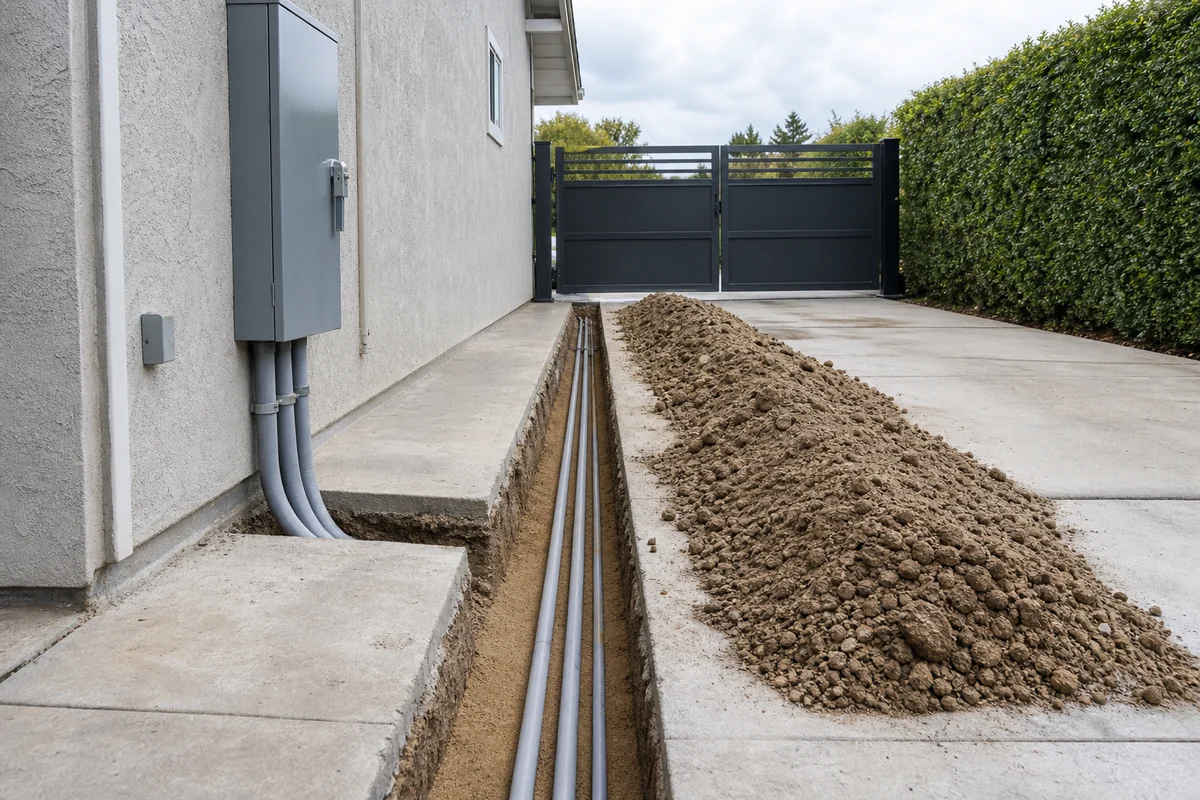
This is the line homeowners never expect and the one that explains most surprise quotes. Distance from the electrical panel to the gate is the biggest single variable in the whole project.
A gate 30 ft from the panel is a short trench. A gate 300 ft up a private driveway is a long trench, heavier wire to manage voltage drop, and a driveway to cut and restore. Hardscape, rock and roots all add to it.
The dedicated 20-amp circuit is not optional either, and neither is separating line voltage from low voltage in the trench.
Labour, permits and commissioning
This line reflects site access as much as hours. A gate at the end of a narrow canyon driveway costs more to install than the same gate with a flat approach.
Permits carry a real cost, they are a small share of the project, and the licensed contractor should pull them and show them as their own line item. Commissioning, safety testing and documented settings belong here too, and their absence is the cheapest thing to cut and the most expensive to discover.
Eight factors that move the price
The table below covers what actually moves a quote, in rough order of impact.
| Factor | Effect on price | Why |
|---|---|---|
| Distance from the panel | High | Trench length, wire gauge, restoration |
| Gate weight and material | High | Larger operator, stronger posts |
| Driveway slope and length | High | Binding risk, gate type, site work |
| Custom and ornamental work | High | Priced per drawing, not per foot |
| Single vs dual operator | Moderate | Two operators, two commissions |
| Access control complexity | Moderate | Device count, intercom vs keypad |
| Power source | Moderate | Solar sizing is rarely the cheaper route |
| Site conditions | Variable | Rock, roots, hardscape to cut and restore |
Solar deserves a plain statement. It is a power option rather than a product, and on a gate with real cycle counts the panel and battery capacity needed to carry it through winter often costs more than trenching a circuit.
Site conditions are the one nobody can quote from a photograph. Rock, tree roots and existing hardscape are found in the trench, which is why a quote built from a site visit is worth more than a quote built from an address.
Where to save and where never to
There are honest savings on a gate quote and there are false ones. The difference is whether the saving is reversible.
Save here:
- Gate ornamentation and custom ironwork, which is aesthetic rather than structural
- Access control in phases, starting with a keypad and adding an intercom later
- Remotes and receivers bought as you need them from the shop
- Keeping an existing gate that is rigid, plumb and moves freely by hand
Never save here:
- Operator sizing, because an operator run at its rated maximum fails early
- Safety devices, which are a UL 325 requirement and not a line to trim
- Wire gauge over a long run, because voltage drop reads as board failure later
- Trenching depth, since the only way to redo it is to cut the driveway again
- Battery backup on a PSPS-affected circuit
- Licensed electrical work
The pattern holds: anything buried, structural or load-bearing is a bad place to economise, because fixing it later means undoing finished work. Anything bolted on or decorative can wait.
Want to know whether the number you have been quoted is fair? Send us the proposal and we will tell you what is in it and what is not (contact us).
Cost of ownership: what a gate costs per year
A gate is machinery with a service life, and budgeting for it annually is cheaper than reacting to it. Annual ownership on a residential system comes down to four things.
An annual service visit covers lubrication, limit and force checks, safety device testing and chain tension. Sealed lead-acid batteries in a DC operator are consumables, typically replaced every three to five years and sooner on a high-cycle or heat-exposed installation, and a dead backup battery is only discovered during an outage.
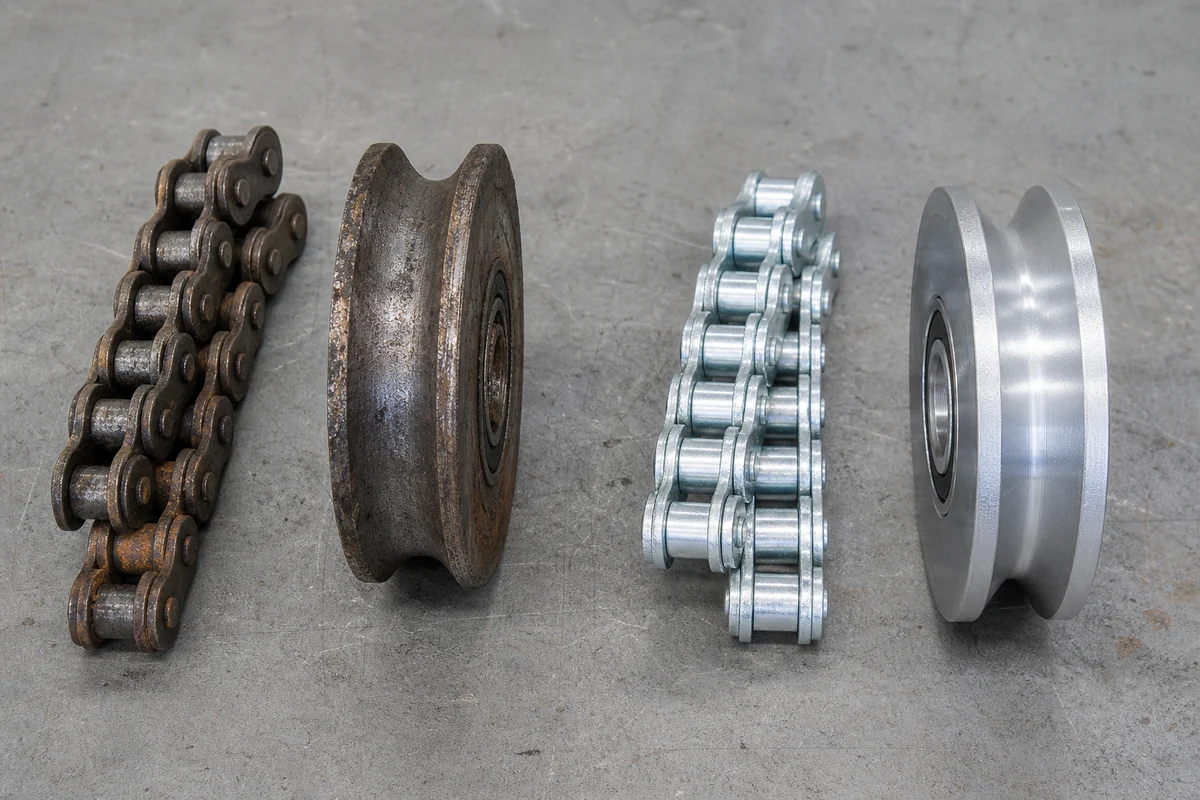
Wear parts are predictable. Chain, V-groove wheels, hinges and photo eyes wear at a rate set by cycles per day and by how much grit the site throws at them rather than by the calendar, and we stock them in gate hardware and gate accessories.
Unplanned repairs are the variable, and the part decides the bill more than the labour does. A board or receiver on a shelf is a service call; a proprietary part on back order is a project. Non-proprietary equipment keeps that number down and non-proprietary equipment keeps that number down because the board or receiver is on a shelf rather than on back order. Electric gate repair on a serviceable system is a part and an hour; on a proprietary system it can be a replacement.
Why identical driveways get wildly different quotes
Three quotes on one driveway can span three times, and it is almost never because one contractor is greedy. It is because they are pricing different scopes and calling them the same thing.
National price calculators make this worse, because they cannot account for LA labour rates, permit requirements, hillside access or how far your panel sits from your gate. A national average is not a number you can hold anyone to.
Red flags in a low bid
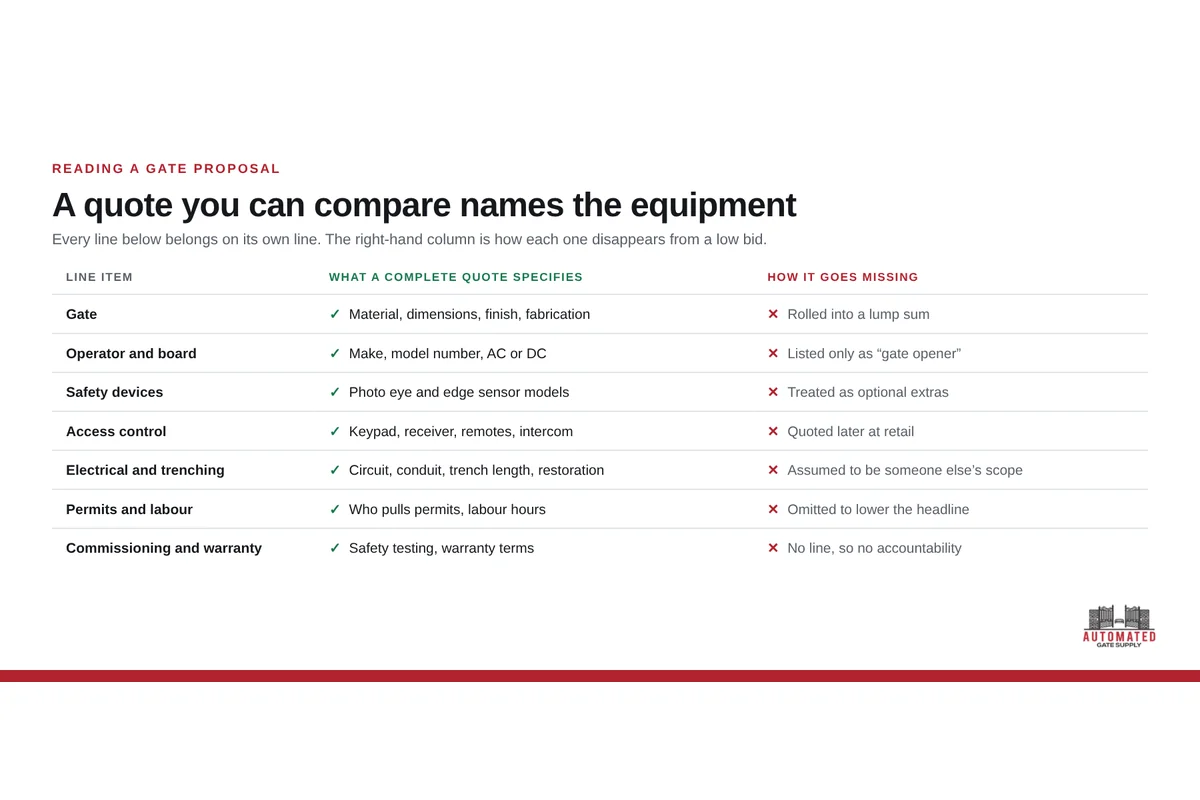
Homeowners send us proposals to look over before they sign, and the cheap ones are missing the same items:
- No safety devices listed, or listed as an optional extra
- No permit line, and no named party responsible for pulling it
- No dedicated circuit, just a tap off an existing one
- A vague “gate opener” with no make or model number
- No commissioning or safety testing line
- Cash-only terms and no licence number on the document
Any one of those is a question to ask. Three of them together is a different job being quoted.
What a fair proposal looks like
A fair proposal is boring to read and easy to compare. Every line is itemised, every piece of equipment carries a make and model number, and the electrical scope is described rather than assumed.
It also states who pulls permits, what the warranty covers, what commissioning includes, and a timeline as a range rather than a promise. When two proposals both do that, the higher one is sometimes the cheaper one over ten years.
Frequently asked questions
How much does an automatic gate cost in Los Angeles?
Ask for the number as a line-item quote rather than a single figure, because “installed” has to mean equipment, electrical, safety devices, labour and commissioning. A quote that undercuts the others substantially is usually quoting a narrower scope rather than a better price.
Why are two quotes for my driveway so far apart?
Because they are pricing different work. The usual gaps are safety devices, the dedicated circuit, trenching depth, battery backup and commissioning, none of which are visible in a finished gate once it is hung and painted. Ask both contractors to itemise with model numbers against each line, and the spread normally explains itself on one page. Where it does not, the difference is usually the operator grade, which is the line that decides whether you are buying three years of service or twelve.
Is it cheaper to automate my existing gate than replace it?
Yes, if the gate is rigid, plumb, and moves freely by hand on sound hinge posts. Automating a sagging or binding gate is not a saving, because the operator absorbs the resistance and fails early, so you pay for it twice. Have the frame and posts assessed before you price equipment.
What does a gate cost to own each year?
Budget for an annual service visit, battery replacement on a cycle for DC operators, and wear parts such as chain, wheels and photo eyes on a gate that runs daily. Repairs are the variable, and serviceable non-proprietary equipment keeps them lower because the parts are stocked rather than ordered.
Does solar make an automatic gate cheaper?
Rarely. Solar avoids a trench, but sizing a panel and battery bank to carry real cycle counts through shorter winter days often costs more than running a circuit, and undersized solar systems are a common cause of gates dying in January. It makes sense where trenching is genuinely impractical.
Do I need a permit, and does it add much?
Electrical work for a new dedicated circuit generally requires a permit, and structural review depends on your jurisdiction. The fee is a small share of the project, and the licensed contractor should pull it and show it as a line item.
Get a line-item quote with model numbers on it
Send us your opening width, gate material and roughly how far the gate sits from your electrical panel, and we will measure properly and give you a written quote itemised line by line with model numbers rather than a lump sum. If you already have proposals, bring them and we will go through what each includes.
Call (818) 765-3636 or send your site details through our contact page (contact us). Because we stock the operators, boards and parts we install, the quote and the part you need in year six come from the same company. Current offers are on our promotions page (see current promotions), and previous projects on (read our testimonials).