
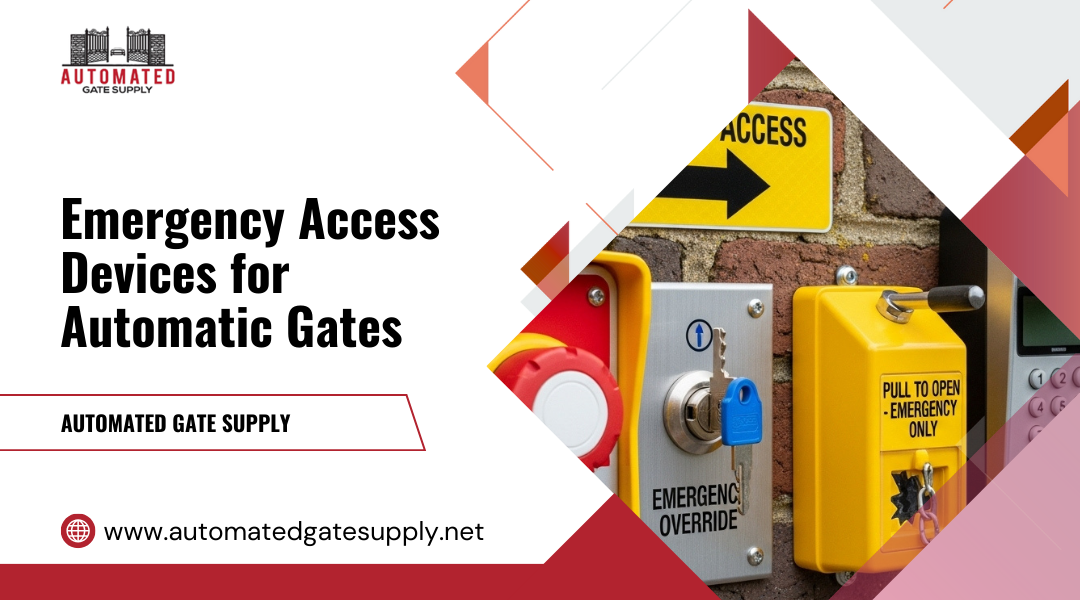
When every second matters during an emergency, automatic gates can either help or hinder response teams. Whether protecting a residential complex or a commercial yard, having the right emergency access system ensures rapid entry for fire, police, or medical personnel. You improve safety and avoid costly property damage when your gate uses certified devices like Knox Boxes, key switches, or padlocks that let first responders in without delay.
You often see these systems installed on electric gates across Los Angeles at apartment buildings, schools, and industrial sites. They work with standard gate operators to provide secure yet immediate access through a master key or electronic override. Choosing the correct setup means balancing dependability, response time, and system complexity—especially in settings that must meet local fire or safety codes.
At Automated Gate Supply in North Hollywood, you can explore practical solutions designed for how your property functions. With decades of experience and a full range of gate automation equipment, their team helps you understand when and why you need devices like Knox emergency access systems—and how to integrate them into both new and existing gates.
Situations Where Emergency Gate Access Becomes A Functional Requirement
Emergency gate access systems matter most when quick entry can protect people or property. You need reliable devices that let first responders act fast without damaging gates or locks. When every second counts, Knox Boxes, key switches, and other access tools become functional rather than optional.
In residential communities, gated driveways or parking structures often rely on automated systems. During fire or medical emergencies, responders must reach homes or vehicles without delay. A mounted Knox Box holding master keys or access cards lets emergency crews unlock entrances immediately.
Commercial and industrial sites also depend on secure yet accessible perimeters. You might have fenced compounds, warehouses, or parking lots controlled by electronic gates. Installing a Knox key switch allows emergency personnel to open these gates using a standard fire department key, even when power fails.
Certain weather conditions or technical issues can disable automatic gate systems. In those cases, manual emergency access points ensure continuity. For example, a Knox Padlock or override switch lets firefighters lift gates manually when the electric motor is offline.
| Scenario | Typical Access Device | Purpose |
|---|---|---|
| Fire emergencies at gated homes | Knox Box | Provides keys for entry without damage |
| Power or system failure at industrial gate | Key Switch / Padlock | Allows manual gate release |
| Medical emergencies in gated communities | Knox Box / Entry Key Switch | Enables rapid responder access |
By planning for these situations, you maintain both everyday security and emergency readiness.
Defining The Operational And Regulatory Boundaries Of Emergency Access Systems
Emergency access systems on automated gates serve a specific role: they allow first responders to enter when other controls fail. These systems must follow safety codes while maintaining property security. Understanding how regulations, user needs, and design limitations intersect helps you make compliant and reliable choices for gate installations.
Distinction Between Emergency Access, Convenience Access, And Security Controls
You need to recognize how each type of access serves a different purpose. Emergency access devices, like the Knox Box or fire department key switches, let authorized responders override normal restrictions in urgent situations. They operate separately from the primary access control systems used by residents, employees, or visitors.
Convenience access serves routine entry, such as through keypads, RFID readers, or remote transmitters. These systems balance security with ease of use but cannot interrupt or delay emergency access.
Security controls—including intercoms and card readers—protect the property from unauthorized entry. In contrast, emergency systems must bypass these mechanisms when activated. When you design a gate setup, you must ensure emergency inputs connect directly to the gate operator’s open signal so they respond instantly regardless of existing faults or user permissions.
| Access Type | Purpose | Control Authority |
|---|---|---|
| Emergency Access | Bypass restrictions for responders | Fire/police/EMS only |
| Convenience Access | Day-to-day user operation | Property users |
| Security Controls | Prevent unauthorized entry | System administrator |
Jurisdictional Authority Versus Property Owner Discretion
Emergency access systems fall under both local fire codes and national safety standards like UL 325. Your design choices must follow what the Authority Having Jurisdiction (AHJ)—often the fire department—requires. Many fire districts specify the use of Knox key switches or lock boxes that match district master keys to maintain uniformity.
You may choose your own access control products, but you cannot change or bypass approved emergency hardware. Installing nonstandard devices, such as proprietary keypads or transmitters, can create compliance issues or delay fire department response. Always confirm requirements with local permitting offices before installation.
Property owners have discretion only in how these systems integrate aesthetically or functionally. The method of emergency activation itself, including mounting height, labeling, and visibility, usually follows public safety guidelines set by the AHJ.
Conditions Intentionally Outside The Scope Of Gate-Based Access Devices
Gate-based emergency systems are not designed to handle every scenario. They focus on vehicular entry points and cannot substitute for broader building access or personal safety systems. For example, they do not regulate pedestrian access, internal door locks, or alarm panel overrides. Each of those falls under different security or fire code sections.
You must also remember that these devices assume a functioning gate structure. They do not compensate for mechanical blockages, severe weather damage, or electrical shorts unrelated to the operator itself.
Backup batteries or fail-safe release mechanisms address power loss, but full manual operation requires mechanical gates that open freely when unlocked. Any situation beyond that—like structural collapse or vehicle impact—falls outside the operational scope of electronic emergency access systems. Understanding these limits keeps your design realistic, compliant, and effective during actual emergencies.
System Logic Behind Common Emergency Access Mechanisms
Emergency access devices for automatic gates rely on specific design logic that allows first responders to bypass standard security controls without damaging equipment. These systems balance security integrity, power management, and manual fallback to ensure accessibility under all conditions. The core mechanisms often combine electrical, mechanical, and credential-based elements that interact through coordinated triggers.
Credential-Based Access Systems And Controlled Physical Keys
Credential-based access devices use authorized tools such as a master key, electronic credential, or smart lock override. The Knox key switch is an example—it uses a controlled physical key recognized by authorized agencies, like local fire departments. Once the device confirms the credential, it sends a signal to open the gate circuit or unlock a deadbolt.
Unlike standard user keypads, emergency units feature tamper switches that detect unauthorized attempts to open the enclosure. Some models include a backlit keypad for visibility in low light without affecting security. In newer automated gate systems, this logic extends to access codes that trigger auto-unlock under emergency credentials.
Most jurisdictions link these credentials to a central master key system shared among multiple agencies. This design keeps property owners and response teams coordinated while preventing uncontrolled duplication of keys or override codes.
Electrical Interruption, Fail-Safe States, And Power Dependency
Gate openings rely on low-voltage circuits that move mechanical arms or release locks. During normal operation, power supplies maintain an engaged or locked state. In emergencies, a system such as a Knox key switch or signal relay breaks or redirects current flow, allowing the gate to open.
Many models use a fail-safe design, which automatically unlocks the gate when power is lost. Others follow a fail-secure logic that stays locked until power returns, typically for higher-security facilities. The choice depends on the property’s safety plan and risk assessment.
Backup batteries or manual resets ensure that gates continue to function during local outages. Automatic sensors or networked controllers check the circuit status and confirm whether a lock is disengaged after activation.
Mechanical Release Paths And Human Intervention Thresholds
Mechanical release systems provide the last layer of access if power or signal routes fail. These are simple, physical methods such as keyed padlocks, deadbolts, or latch releases connected to an emergency override. A Knox padlock or similar model uses a rugged metal body and keyed interface shared across authorized response units.
When a technician, firefighter, or other first responder inserts an authorized key, the mechanism releases a lever or latch that disconnects the locking bolt. This manually overrides electrical control without permanent damage.
Mechanical overrides also define a human intervention threshold, meaning someone must be physically present to perform the release. This feature prevents remote tampering or system bypassing while maintaining dependable access for trained users. Often, these devices include weather covers and clear identification tags to reduce misuse and wear in outdoor installations.
Interpreting Tradeoffs Between Security Integrity, Response Time, And System Complexity
Designing emergency access for automatic gates requires balancing fast entry for responders with strict security to prevent misuse. Each technology—whether a Knox Box, key switch, or digital override system—affects how quickly access is granted, how data integrity is maintained, and how complex the system becomes over time. Achieving dependable reliability means weighing these tradeoffs carefully during installation and configuration.
Risk Introduced By Permanent Access Devices
Permanent access devices increase efficiency for emergency crews but can expose your property to new vulnerabilities. A Knox Box ensures authorized entry without damage, yet it must be secured against unauthorized duplication of master keys. Likewise, a key switch is simple and quick but can be bypassed if placement or enclosure security is weak.
Every added access path represents a potential attack surface. You limit exposure by using tamper-resistant enclosures, audit logging, and periodic rekeying. Consider how authentication methods—like coded entry or encrypted RFID—reduce misuse without slowing legitimate access. Clear, documented maintenance schedules also help sustain consistent security integrity over time.
| Access Device | Benefit | Security Weakness |
|---|---|---|
| Knox Box | Immediate key-based entry | Compromised master key risk |
| Key Switch | Simple and reliable | Physical tampering possible |
| Digital Access Panel | Encrypted control | Complexity in setup and upkeep |
Reliability Under Failure Scenarios And Environmental Stress
You must plan for how gate systems respond when hardware, network, or power components fail. Reliability means the gate must still allow safe emergency entry even in adverse conditions like earthquakes, heat, or power outages. Redundancy—backup power, manual overrides, or dual-sensor verification—improves availability but raises system complexity.
Testing under stress, such as temperature variation, voltage drops, or signal interference, identifies weak points. Seal connectors and weatherproof control panels to prevent corrosion or short circuits. Building gates with fail-safe defaults—for instance, switching to manual unlock when power is lost—can prevent system lockouts while still preserving controlled entry rights.
You should document response times during drills and maintain clear procedures so responders know exactly how each fallback mode functions.
Long-Term Operational Consequences Of Design Shortcuts
Cutting corners during system design or installation often leads to hidden costs later. Skipping regular firmware updates or failing to standardize access protocols can cause component incompatibility. These shortcuts degrade reliability and stretch troubleshooting timelines during emergencies.
Using cheap switches or improperly rated electrical components may seem cost-effective initially. Over time, heat, wear, or electrical surges can create intermittent failures that delay gate response. Complexity increases as technicians patch issues with add-ons or nonstandard wiring.
To avoid these issues, implement preventive maintenance logs and establish vendor support agreements. Regularly audit both the software and the physical devices to catch small problems before they interrupt access or compromise integrity. Reliable long-term operation depends on disciplined attention to each subsystem’s performance and configuration.
Resulting Configurations Across Property Types And Use Environments
Emergency access setups vary with each property’s layout, occupancy, and security needs. Device types and installation points must match how first responders will approach the site and how authorized users interact with it daily. Proper configuration ensures quick entry during an emergency while maintaining day-to-day security and compliance with local codes.
Multi-Tenant Residential And Mixed-Use Properties
For apartment complexes, condominiums, and mixed-use developments, you often need multiple entry points for both vehicles and pedestrians. A Knox key switch installed near the main gate allows fire or law enforcement personnel to open the gate without damaging it. Secondary access points—such as pedestrian gates or garage entries—may also use Knox padlocks or gate key switches for consistent key control.
Common setups include:
| Feature | Configuration Example | Purpose |
|---|---|---|
| Primary Gate Access | Knox key switch near keypad | Emergency vehicle entry |
| Backup Access | Knox padlock on manual gate latch | Provides secondary entry |
| Shared Areas | KnoxBox for keys to shared utility rooms | Maintains secure access for fire or maintenance |
When properly placed and labeled, these devices reduce response time. Your local fire department typically confirms required mounting locations and device heights.
Commercial, Industrial, And Restricted-Access Facilities
Commercial and industrial properties rely on access control systems that balance fast emergency response with asset protection. You usually install Knox Boxes near building entrances, utility rooms, or perimeter gates to store master keys, access cards, or override credentials.
Larger facilities may combine KeySecure units with electronic audit tracking to record every instance of master key removal. In fenced or high-security areas, Knox padlocks offer shared access between facility staff and multiple responding agencies.
In restricted zones such as warehouses or energy plants, devices must meet the site’s internal safety protocols. Mount Knox components in visible, code-approved areas and maintain them as part of routine safety inspections.
Public-Facing Sites With Overlapping Agency Access Requirements
Schools, hospitals, government campuses, and large event venues often serve multiple jurisdictions, which adds complexity to emergency access planning. You may need to coordinate with both fire and police departments when selecting device types and placement.
A Knox Remote Power Box can cut building power during an emergency, while a Knox Gate & Key Switch can give responders direct entry to restricted drives or courtyards. Document cabinets at control rooms or command posts store critical maps, security schematics, and emergency contact lists.
When agencies share master key privileges, maintaining an audit trail of all device activity helps prevent unauthorized use. Consistent labeling and updated records keep responders confident that each access point works as expected when seconds matter.